


Middelkerca on the island of Testerep (1218 to 1875)
Middelkerke lies on the former island of Testerep, which joined the mainland in the Middle Ages.
- Middelkerca (1218): Middelkerke is first mentioned in 1218 as Middelkerca, because it lay in the middle of the long coastal island of Testerep.
- No longer an island: the wide Testerep channel between the island and the mainland was dammed at Nieuwendamme and reclaimed in the second half of the 12th century.
- A parish of its own (1293): Middelkerke became an independent parish in 1293; in 1334 floods destroyed the village.
- Lombardsijde, a lost town: nearby Lombardsijde, first called Yde, was mentioned as a town in 1252, and its coat of arms can still be seen on the town hall of Bruges; in 1413 it was sold to Nieuwpoort and lost its town rights.
- Roman salt: in Roman times salt was produced in Leffinge by letting seawater evaporate.
- War around 1600: during the religious wars the church was partly destroyed, and the village suffered from the Battle of Nieuwpoort (1600) and the Siege of Ostend (1601 to 1604).
- A fishing village: in the following centuries Middelkerke was a small fishing village along the Graningatevliet.

From fishing village to seaside resort (1875 to 1914)
From 1875 a fashionable resort grew up by the sea, separate from the old village.
- A resort company (1876): in 1876 the Société Anonyme des Bains et des Dunes de Middelkerke et de Westende was founded in Brussels; among other things it built the Hotel de la Digue.
- Belgium's first local tram (1885): in 1885 Belgium's first local tramway line, a steam tram from Ostend, ran through Middelkerke; in 1897 the first electric tram along the coast followed, the forerunner of the Coastal Tram.
- The first casino (1891): a wooden casino was built in 1891, and a new casino opened in 1914.
- The boulevard (1900): around 1900 the boulevard was laid out with villas; this created Middelkerke-Bad next to the old Middelkerke-Dorp.
- The Dronkenput: at the end of the 19th century a round reinforced concrete water reservoir was built, which the groundwater pushed up at an angle; this Dronkenput, or drunken well, is now a curiosity.
- Villa Cogels and villa Doris: the villas Cogels and Doris on the promenade are the last remains of the Belle Époque seafront.
Two world wars and reconstruction
Lying right next to the Yser front, Middelkerke was hit hard in the First World War.
- On the Yser front: in the First World War Middelkerke lay very close to the Yser front; the village was evacuated and the church tower was blown up.
- Everything damaged: at the liberation in 1918 every house in Middelkerke was damaged.
- Sint-Willibrorduskerk: the Sint-Willibrorduskerk, whose tower dated from the 17th century, was rebuilt in the 1920s and extended with a second tower in the early 1930s.
- Town hall (1924): the town hall was built in 1924 and 1925 and has been a listed monument since 2002.
- Apartments and Atlantic Wall: the first apartment blocks appeared in the 1930s; in the Second World War the Atlantic Wall was built here, but the damage remained limited.
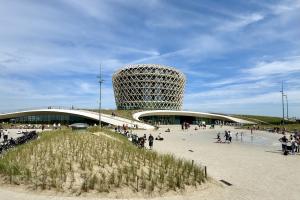
Mass tourism, casino and comic town
After the war Middelkerke became a popular resort for a wide public, with a casino and comic figures as eye-catchers.
- Mass tourism: from the 1950s mass tourism arrived and many apartment blocks rose on the promenade.
- Comic town: Middelkerke holds a comics festival every year, and the promenade is lined with statues of famous comic characters such as Jommeke, Nero, Kiekeboe, Lucky Luke, Spirou and Suske and Wiske.

